Where does a herniated intervertebral disc occur? What is a herniated intervertebral disc? What other disc changes exist? What are the symptoms of a herniated disc? How is the DIAGNOSIS made? Frequently Asked Patient Questions: Purpose: To address bothersome pain; reducing and relieving pain and symptoms will improve quality of life.
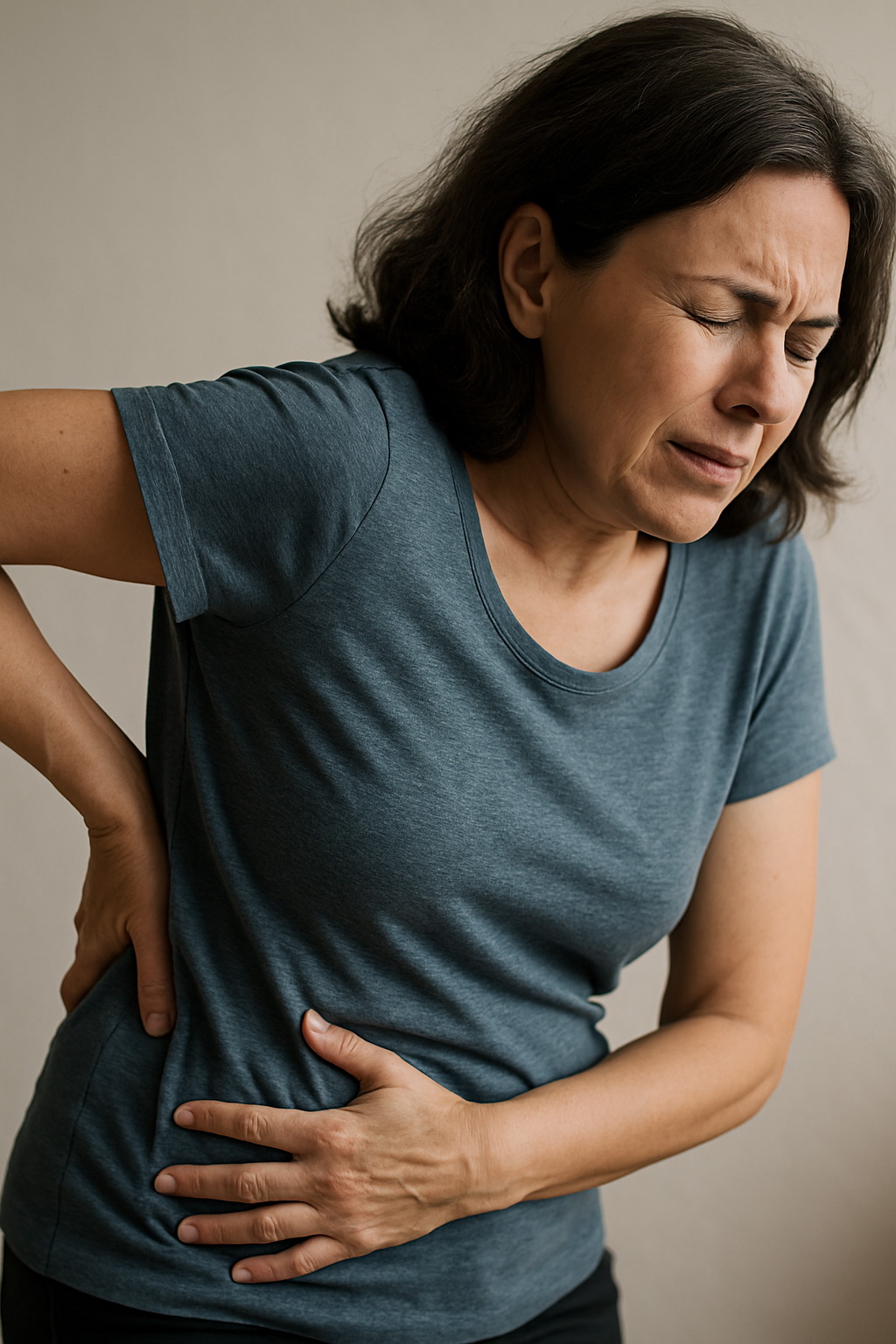
Low Back Pain Low back pain is a common symptom of spinal disorders. This persistent pain in the lumbar region may result from:
-
Inactivity (sedentary work, lack of exercise)
-
Overloading of the spine with weight and vibration (repetitive lifting)
-
Incorrect posture, including kyphosis, lordosis, and scoliosis
-
Leg length discrepancy
Or,
Low back pain may simply be caused by muscle spasm (“muscle strain”) due to a sudden movement or poor posture.
However, a common spinal condition may also be a herniated intervertebral disc (disc herniation).
Let’s start from the beginning…
Structure of the Spine The spinal column consists of:
-
7 cervical vertebrae (Cervical spine C1–C7)
-
12 thoracic vertebrae (Thoracic spine T1–T12)
-
5 lumbar vertebrae (Lumbar spine L1–L5)
-
5 sacral vertebrae (fused, forming the sacrum S1–S5)
-
4–5 coccygeal vertebrae (fused, forming the coccyx)
Where Does a Herniated Disc Occur? The intervertebral disc is located between each vertebral body of the spine. It provides support and elasticity, allowing controlled mobility of the spine.
Externally, it consists of the annulus fibrosus (collagen layers) surrounding the nucleus pulposus, which has a gelatinous, flexible texture due to its high water content. It is a highly organized structure with distinct anatomical and biochemical properties.
What Is the Role of the Intervertebral Disc? The intervertebral disc plays a vital role in:
-
Shock absorption
-
Load distribution within the spine (e.g., lifting weights)
Discs act as “cushions” during daily mechanical stress on the spine.
Disc herniation can occur in the cervical, thoracic, or lumbar spine.
In the lumbar region, herniation most commonly occurs at L4–L5 and L5–S1, and less frequently at L3–L4.
What Is a Herniated Intervertebral Disc? It is the displacement of the nucleus pulposus along with damage or rupture of part of the annulus fibrosus.
Possible conditions include:
-
Mild displacement, where the nucleus slightly bulges through the annulus → disc protrusion
-
Greater displacement, causing partial rupture of the annulus → progressive formation of a disc herniation
What Other Disc Changes Exist? Degenerative Changes Degeneration refers to any fibrotic change, including:
-
Spinal stenosis (narrowing of the spinal canal, compressing nerves or even the spinal cord)
-
Annular bulging
-
Wear and structural changes of the vertebral bodies
-
Changes in annular fibers
-
Osteophytes (bone spurs) in the joints
-
Acute injury or chronic degenerative changes (accumulated micro-traumas) leading to disc weakening
-
Cumulative effect of repeated stress, such as poor posture (kyphosis, lordosis, scoliosis), prolonged sitting, excessive exercise, etc.
Traumatic Changes
What Are the Symptoms of a Herniated Disc? Symptoms depend on the severity of the condition:
-
Pain: the extruding nucleus pulposus contains proteins that can trigger inflammation
-
Nerve compression may cause paresthesia and radicular pain
Patients with radiculopathy (disc herniation compressing a nerve root) often report:
-
Numbness
-
Tingling
-
Cold sensations in the limbs
Sometimes symptoms indicate sensory disturbances (hypoesthesia or hyperesthesia).
How Is the Diagnosis Made? Magnetic Resonance Imaging (MRI) is the best imaging method for evaluating intervertebral discs.
A simple X-ray may also be used for differential diagnosis (e.g., tumors). If spinal narrowing is detected, disc herniation is often present.
-
Stay calm – in most cases, it is not serious
-
Complete immobilization is not a solution, especially prolonged bed rest
-
Move within pain limits
-
Find relieving positions, such as:
-
Side-lying with a pillow between the hips
-
Supine position with a pillow under the knees
-
-
Topical anti-inflammatory creams may provide temporary or minimal relief
-
Do not self-diagnose and avoid advice from non-professionals
A Few Tips for Low Back Pain
-
Obesity: increased body mass accelerates disc degeneration due to increased mechanical load
-
Smoking: contributes to disc degeneration and herniation by reducing hydrostatic properties necessary to counter compressive forces
⚠️ Important Warnings
Beyond advice, your physiotherapist will recommend appropriate exercises and mobilization techniques to manage pain. Each exercise program is individualized and adapted to the patient.
-
Will I be in pain forever?
-
Will I be able to walk again without pain?
-
Will I need surgery?
Frequently Asked Patient Questions
Lack of proper information and the spread of misconceptions about low back pain cause confusion, anxiety, and insecurity, which further intensify symptoms.
That is why proper evaluation and a well-designed therapeutic exercise plan by your physiotherapist are essential.
Purpose Managing bothersome pain—reducing and relieving pain and symptoms—will significantly improve quality of life.
Consult your physiotherapist — every hour counts!
BSc, MSc, NDT – Physiotherapist
Santoriniou Maria-Georgina
KDIF EFALTIRIO
REFERENCES
Devereaux, M. W. (2007, May). Anatomy and Examination of the Spine. Neurologic Clinics. https://doi.org/10.1016/j.ncl.2007.02.003
Eisenstein, S. M., Balain, B., & Roberts, S. (2020). Current Treatment Options for Intervertebral Disc Pathologies. CARTILAGE, 194760352090766. https://doi.org/10.1177/1947603520907665
Kadow, T., Sowa, G., Vo, N., & Kang, J. D. (2015). Molecular Basis of Intervertebral Disc Degeneration and Herniations: What Are the Important Translational Questions? Clinical Orthopaedics and Related Research, 473(6), 1903–1912. https://doi.org/10.1007/s11999-014-3774-8
Kim, J. Y., Jeon, K. J., Kim, M. G., Park, K. H., & Huh, J. K. (2018). A nomogram for classification of temporomandibular joint disk perforation based on magnetic resonance imaging. Oral Surgery, Oral Medicine, Oral Pathology and Oral Radiology, 125(6), 682–692. https://doi.org/10.1016/j.oooo.2018.02.009
Ma, J., Wang, R., Yu, Y., Xu, X., Duan, H., & Yu, N. (2020). Is fractal dimension a reliable imaging biomarker for the quantitative classification of an intervertebral disk? European Spine Journal. https://doi.org/10.1007/s00586-020-06370-2
Smit, T. H. (2018, December 1). Mechanobiology to repair the herniated disc. EBioMedicine. Elsevier B.V. https://doi.org/10.1016/j.ebiom.2018.11.014
Vaegter, H. B., Ussing, K., Johansen, J. V., Stegemejer, I., Palsson, T. S., OʼSullivan, P., & Kent, P. (2020). Improvements in clinical pain and experimental pain sensitivity after cognitive functional therapy in patients with severe persistent low back pain. PAIN Reports, 5(1), e802. https://doi.org/10.1097/pr9.0000000000000802